



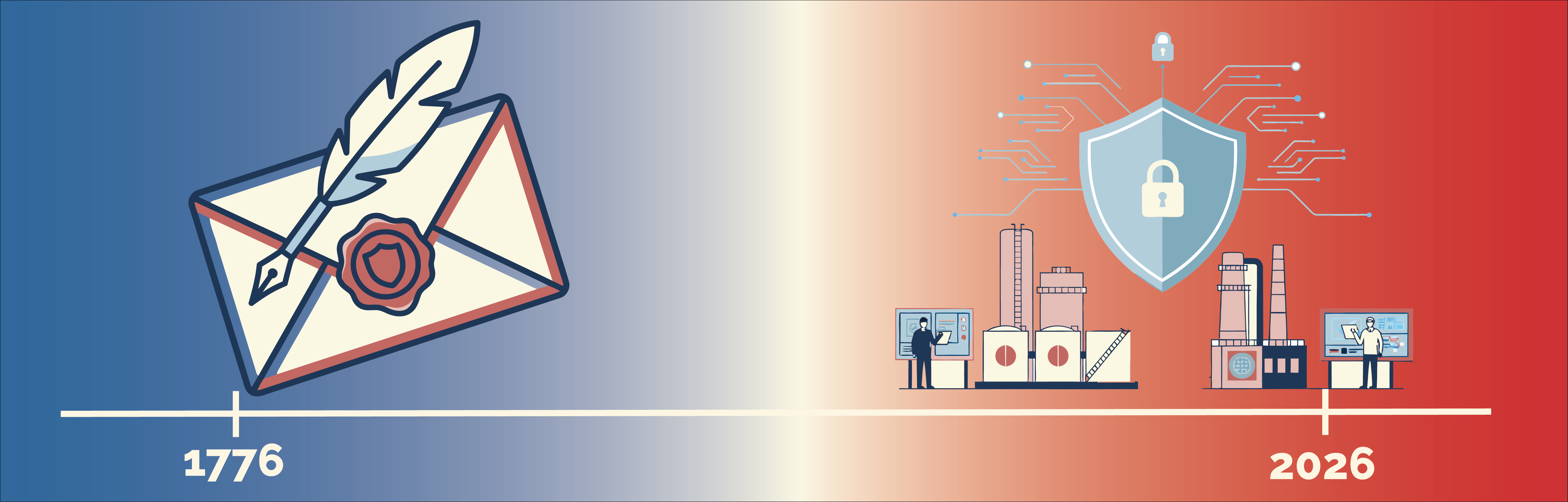
America was born in secrecy. Long before there were classification markings or national security directives, a small group of colonial legislators understood something essential: the survival of a revolution depended on keeping the right information out of the wrong hands.
Building the Architecture
George Washington didn't wait for formal policy. Drawing on British military practice, he marked his own communications "secret" or "confidential" — an informal classification system that would eventually become codified U.S. government doctrine. The Articles of Confederation later made it official, formally excluding "treaties, alliances, or military operations" from public disclosure.
Perhaps the best example was the Culper Ring. Formed in 1778, the spy network Washington personally directed used invisible ink, numerical codes (46 for artillery, 739 for Virginia), book-based ciphers drawn from Blackstone's Commentaries, and dead drops signaled by laundry on clotheslines. Not one member was ever captured. Their operational discipline remains a case study in compartmentalization and a direct ancestor of modern cybersecurity practice.
The Same Fight, New Battlefield
The secrets that mattered in 1776 were troop positions, supply lines, and foreign negotiations. Today, they live inside industrial control systems, computer-aided design files, and defense procurement contracts. The targets have shifted from military encampments to manufacturing facilities — but the strategic logic is identical. Whoever controls information about production capacity and supply chain dependencies holds a decisive advantage.
Manufacturing is now the most targeted sector for cyberattacks, a distinction it has held for four consecutive years (IBM X-Force Threat Intelligence Index, 2024). The systems running American factories — programmable logic controllers, connected quality sensors, enterprise resource planning platforms — represent an attack surface that grows with every advance in industrial digitization. A vulnerability in a factory's operational technology network isn't just a business continuity problem. It's a national security problem. The founders understood this dynamic when they built the machinery of secrecy into the architecture of the republic.
The New Guardians
Two Manufacturing USA institutes are carrying that tradition forward.

MxD — Manufacturing x Digital — is headquartered in Chicago and serves as the Department of War's designated National Center for Cybersecurity in Manufacturing. With more than 360 industry partners, MxD helps manufacturers achieve Cybersecurity Maturity Model Certification (CMMC) readiness, prepares service members for cybersecurity careers in the manufacturing sector, operates a Cyber Resource Hub for the broader industrial community, and more. Think of it as a modern Committees of Correspondence — a networked ecosystem built specifically to protect industrial information.

CyManII — the Cybersecurity Manufacturing Innovation Institute, headquartered in San Antonio — brings together universities, national laboratories, and industry to secure energy-efficient manufacturing and the supply chains that sustain it. Its coalition model recalls the colonial networks that protected the revolution's most sensitive operations.
Both institutes operate from the same conviction the founders held: protecting information isn't a compliance exercise, it's a foundational requirement of national capability. The manufacturer whose processes are stolen or whose supply chain is disrupted by ransomware has suffered the digital equivalent of having dispatches intercepted by a British courier during the Revolution. The consequences are strategic, not just operational.
From the Secret Journals to secure networks, the imperative hasn't changed. Only the battlefield has.
References:
- National Security Agency. Revolutionary Secrets: Cryptology in the American Revolution. 2012. A rare government publication that traces modern signals intelligence back to Washington's spy networks.
- Central Intelligence Agency. Intelligence in the War of Independence. The CIA's own institutional history of the Revolution's covert operations.
- George Washington's Mount Vernon. "The Culper Code Book." The actual numerical cipher used by Washington's spy ring, with annotations.
- Library of Congress. "Secret Codes for Washington's Spies." Exhibition text on the cryptographic tools of the Revolution.