




On the evening of July 9, 1776, a crowd in lower Manhattan listened to the Declaration of Independence read aloud by order of General Washington. Then they did something practical. They walked to Bowling Green, threw ropes around the gilded lead equestrian statue of King George III, and pulled it down.
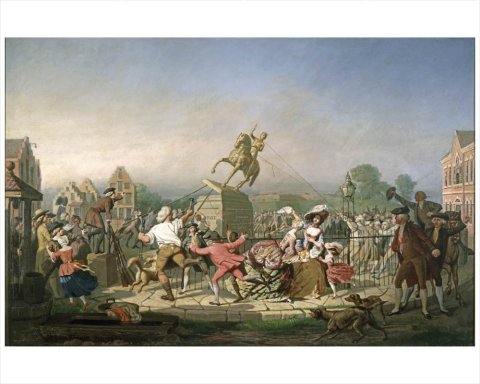
The statue wasn't left in pieces on the cobblestones. It weighed roughly 4,000 pounds, and lead was far too scarce to waste. The fragments were shipped north to Litchfield, Connecticut, where General Oliver Wolcott set up a shed in his orchard. His family and neighbors got to work. The result: 42,088 musket balls for the Continental Army. As New York postmaster Ebenezer Howard wrote to General Horatio Gates, the king's "statue here has been pulled down to make musket balls of, so that his troops will probably have melted Majesty fired at them."
That's the circular economy at its most visceral — and its most consequential.
Why It Wasn't a Choice
By March of 1776, lead was so scarce in New York that it was being pried from the lead-glass windows of buildings across the city. Britain's Prohibitory Act of 1775 had severed trade, cutting off not just finished goods, but the raw materials needed to make them. The Continental Army was outgunned, undersupplied, and perpetually short of cash. What the patriots had — what no blockade could touch — was ingenuity, skilled hands, and a culture of material resourcefulness built over generations.
When you can't buy what you need and can't import what you can't make, you look at what already exists and transform it. That founding logic animates the REMADE Institute today — a Manufacturing USA public-private partnership dedicated to accelerating the circular economy through reuse, remanufacturing, recovery, and recycling of metals, polymers, fibers, and electronics.
The Original Remanufacturers
Lead was the lifeblood of 18th-century warfare, and pewterers were already in the recycling business — their trade involved melting worn household alloys and recasting them. When imports dried up, those same crucibles went to work on military supply. Archaeological analysis of musket balls from the Battle of Monmouth and Fort Motte has found lead-tin alloy compositions consistent with pewter feedstock, bearing metallurgical signatures similar to the King George III statue. The recycled king may literally have been fired at his own troops.
Blacksmiths did the same with weapons: broken musket locks cannibalized to repair others, worn barrels re-bored to a larger caliber, farm implements beaten into pike heads. The local blacksmith was the original remanufacturer — assess, restore, redirect. That's a near-perfect description of REMADE's Remanufacturing and End-of-Life Reuse work today.
The Furnace Patriots
By 1775, the American colonies produced roughly 15 percent of the world's iron. When war came, ironmasters pivoted their furnaces from domestic goods to military material without building a single new facility. Raw material flows didn't change — iron ore, charcoal, limestone flux — only the end product did. That's precisely the logic behind REMADE's Manufacturing Materials Optimization work: use secondary feedstocks and reduce in-process losses to serve new needs without requiring new infrastructure. The ironmasters proved the model. Some paid for it with their lives — Valley Forge ironworks and Mount Holly ironworks were burned to the ground by British forces.
Homespun, Saltpeter, and the Women Who Supplied the Army
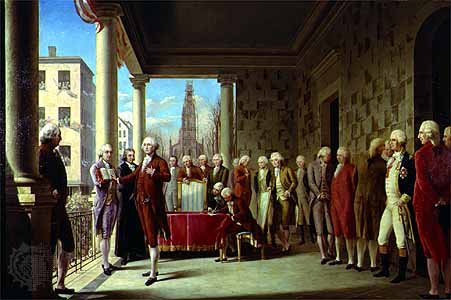
Women became the primary textile suppliers for the Continental Army — uniforms, tents, blankets, cartridge bags. Hartford women alone were assigned quotas of 1,000 coats and vests and 1,600 shirts for 1776. Washington wore a homespun brown wool suit to his inauguration. Nothing was wasted: old cloth became bandages, scraps became cartridge paper, worn sailcloth became haversacks.
The Second Continental Congress distributed a pamphlet teaching citizens to produce saltpeter from stable runnings, slaughterhouse sweepings, old mortar, and wood ash, which was composted, leached, and recrystallized into potassium nitrate. The government offered half a dollar per pound for the domestic supply. In chemical terms, this was nitrogen recovery from secondary organic waste streams. REMADE's Recycling and Recovery work operates on the same logic, just with considerably better equipment.
Paul Revere and the Long Game
Paul Revere's arc from silversmith to cannon-founder to industrial manufacturer is one of the Revolution's underappreciated stories. He cast cannons, established gunpowder mills, and afterward built a copper rolling mill that brought hull-sheathing technology to American shipbuilding. Britain had guarded that technology as a military secret. Revere produced the copper sheathing for the USS Constitution. His entire career embodies what REMADE calls Design for Re-X: materials and supply chains conceived from the start so components can be efficiently recovered, redirected, and remanufactured.

Manufacturing accounts for 25 percent of U.S. energy consumption at an annual cost of roughly $150 billion [ref]. Recycled energy transition minerals are projected to reach $200 billion in market value by 2050, and recycling could reduce the need for new mine development for copper and cobalt by 40 percent. REMADE brings together industry, academia, national laboratories, and trade associations in 44 states, with member organizations employing approximately 1.4 million people.
The colonial ironmasters, pewterers, gunsmiths, and spinners who built America's first circular economy did it without federal R&D funding, without research partners, without digital tools, and with the British Army actively trying to burn their facilities down. They succeeded. There's no credible argument that we can't do the same.
References:
- American Revolution Museum. "'Melted Majesty' Musket Ball Discovered at Monmouth Battlefield." The archaeological find that confirmed the King George III statue's material was recycled into ammunition.
- Continental Congress. Essays Upon the Making of Salt-Petre and Gun-Powder. Philadelphia, July 28, 1775. The original government pamphlet teaching citizens to produce gunpowder from household waste.
- National Park Service, Hopewell Furnace National Historic Site. "Hopewell Furnace in the American Revolution." The history of one of the Revolution's most productive iron furnaces.
- Paul Revere House. "Revere's Foundry and Copper Mill." Revere's post-Revolutionary career as an industrial manufacturer, including his copper rolling mill and the USS Constitution.